As promised in my Muse Supremacy Drumming Analysis page, I thought it would be interesting to look more closely at the Intro of this song to analyse its time signature, and see what that means in terms of setting up a click track in your DAW when playing along.
Intro
Essentially, the Intro consists of four “call and response” motifs, the “call” being 4 notes on guitar, and the “response” being 4 notes of drums/orchestra “answering” the guitar. To help better visualize this, which will be useful when looking at notation later on, I think of each call and response being something like this:
ta-ta-ta-ta (pause) da-da-da-da
with the guitar “call” being the “ta-ta-ta-ta” and the drums/orchestra “response” being the “da-da-da-da”.
Time Signature
There is more than one way to notate this song, my preference being to use 4/4 with a quarter note tempo of 80 bpm. This makes sense to me given the rock feel of the main drum beat in the song’s Choruses (kick on 1 and 3, snare on 2 and 4, 8th notes on hi-hat).
For the Intro, although we could consider 4 measures of 3/4 with each measure being one call and response between the guitar and the drums/orchestra, this doesn’t feel right in terms of pulse, and therefore I prefer to notate this as 8 measures of 3/8, ie two measures of 3/8 for each call and response.
Now, let’s complicate matters. We can also consider that there is a 3 over 2 polyrhythm happening here, with each call and response lasting 4 beats, rather than the 3 (one measure in 3/4) or 6 (two measures in 3/8). Here’s a screenshot to show want I mean. The track “CLK 4” (grey) is in 3/8 at 80 bpm per quarter note. The track “CLK 4 106” (yellow-ish) in in 4/4 but at a higher tempo, 106.67 bpm to be precise. However, you can see that these two clicks line up on the “1” of each measure of 3/8.
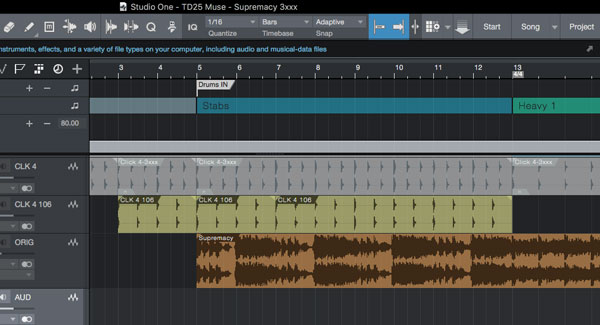
Remember, the music doesn’t change at all, but the two clicks (representing two different time signatures at different tempos) illustrate two ways in which we can feel the pulse in this part of the song.
How the same piece of music can be felt two ways
Let’s look at some notation in order to understand how this works. Each call and response (which is repeated 4 times in the Intro) consists of 4 notes on guitar, a pause, then 4 notes of drums/orchestra, ie something like this:
ta-ta-ta-ta (pause) da-da-da-da
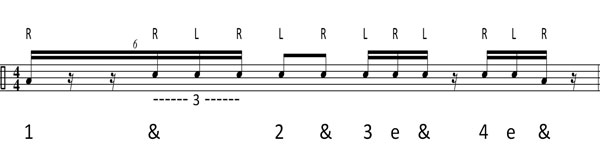
In 3/8 time, each “ta” or “da” is a sixteenth note, with an eighth note rest between call and response:
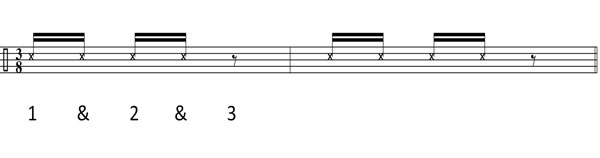
Note: this is dummy notation, in other words ignore that I appear to have notated a snre cross-stick, it’s the note length that matters here for this discussion.
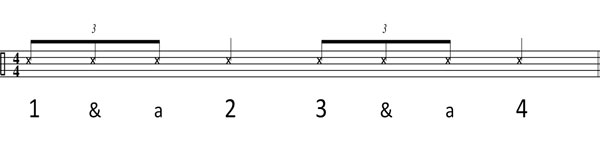
In 4/4 time, each “ta” or “da” is an eighth note triplet, with a quarter note rest between call and response:
Calculating the 4/4 click
Actually, this is just simple maths. We need to calculate the BPM for a 4/4 measure which needs to occupy exactly the same length of time as two 80 bpm 3/8 measures. In other words eight 8th notes at X bpm equals six 8th notes at 80bpm:
80 bpm x 8/6 = 106.67 bpm
Therefore, I created an audio file of a click at 106.67 bpm and added this to a new track in my DAW, and edited the audio regions so that it only plays during the Intro. For the rest of the song I use an eighth note click at 80bpm.
Why bother?
Good question! Well, it’s simply because I find it easier playing the Intro with this new 106.67 bpm click rather than an eighth note click at 80bpm. But it was also an interesting dive into anotehr aspect of music theory, and also a strong reminder that notation and music is exactly like writing about visual art. It’s do-able, but the language (or notation, in the case of music) is an approximation, attempting to convey something that can’t actually be conveyed fully in that medium.
Check out other related content
 Ade Drums