This is a great track for us drummers – lots of variety, drama, dynamics, some cool fills, and a really musical drum part – which makes it a really satisfying song to play along to.
Supremacy is the opening track on Muse’s “2nd Law” album, released on 01 October 2012, and was later released as a single on 20 February 2013. Interestingly, the single is not the album version, but rather a live version recorded at the 2013 BRIT awards. The song had its first live performance on 20 September 2012 and was regularly played during the 2nd Law tour. The drummer is, of course, the marvellous Dominic Howard.
Some fans speculated that this was an attempt at a James Bond theme song, as it certainly has stylistic elements of typical orchestral “007” themes and a certain John Barry-esque feel – especially that lone chord at the end of the song, and the frantic instrumental section towards the end of the song recalls (at least in spirit) part of Wings “Live and Let Die”. It has also been compared to Led Zeppelin’s track “Kashmir” with the use of a “3 over 4” feel (although Kashmir has a higher tempo).
Song Structure
The structure is relatively straightforward, and the key sections are listed below. Timestamps (m:ss) are as per the album version.
- Stabs (0:00) This is the “da-da-da-da” guitar / drums call and response at the very beginning of the song. Each call and response occurs four times.
- Chorus 1 (0:09) Heavy guitar riff, rock drums, orchestra, etc, instrumental only
- Chorus Toms (0:39) Five measures of 3/8 building to a crescendo at the end of the Chorus. I separate this section from the Chorus due to the different time signature.
- Verse 1 (0:45) Snare drum only, low in the mix, playing a cool hand to hand pattern.
- Chorus 2 (2:04) Same as earlier Chorus, but slightly shorter.
- Chorus Toms (2:22) Same as previous.
- Verse 2 (2:28) For us drummers, same as before. Guitar solo, joined by horns later, then vocals.
- Stabs (3:47) Basically a repeat of the “da-da-da-da” intro with the guitar/drums call and response played four times.
- Double Time Section (3:58) High energy, fast and frantic, with guitar solo. For a drummer, this is probably the most technically demanding part.
- Chorus 3 (4:19) Same as previous Chorus, with a different fill.
- Chorus Toms (4:38) Same as before, but this time builds to a dead stop and the end of the song – apart from that lone “007” style guitar chord at the very end.
Tempo and time signatures
For those contemplating doing a cover of this song, there are a couple of points to be aware of:
- some subtle tempo changes
- more than one time signature
According to the tempo map I extracted using Melodyne, the intro and choruses are at 80bpm, the verses at 79.05 bpm, and the double time section at 81.8 bpm (82bpm seems to work, so I’m not sure that Melodyne got this right). These aren’t massive changes but, clearly, if you want to line the song up with the grid in your DAW, you need to set up the tempo changes. In my experience, the tempos mentioned above are correct and everything lines up ok – although some playing around with the start point of the original track will be needed to get it right.
As for time signatures, most of the song is in 4/4. The intro and re-intro “stabs” (the opening da-da-da-da parts) are in 3/4, and the Chorus Toms sections at the end of each Chorus are in 3/8 and 4/8. For the “double time” guitar solo after the second verse, us drummers can think of this being in 4/4, although, from a guitar/bass perspective, there are also sections of 3/4 and 6/4 during this section. We can ignore these variations and treat all of that section as 4/4 – although the phrasing of the lead guitar can be a little off-putting at first until you get familiar with the song.
What about the 4 over 3 feel of the Intro? Although in a 3/4 time signature context we can consider the intro stabs to be four 1/16th notes of guitar, then two sixteenths rest, then four sixteenths of drums/orchestra response, and finally two sixteenths rest (a total of 12 sixteenth notes for each measure), we can also consider these notes as 1/8th note triplets in a 4/4 context, but at a higher tempo. To avoid clogging up too much of this page with this theory stuff, I’ve written a separate Supremacy – Four over Three post to go into all this in more detail, with audio clips.
Setting up a click track
I have seen some transcriptions that show the song’s tempo as 160 bpm, which I don’t really agree with. For me, there is a clear eighth note pulse in both the choruses and verses, and therefore the logical tempo is 80 bpm.
I like an eighth note click for all sections, whether in 3/4, 4/4, 3/8 or 4/8. This is easy to do in Studio One, as it is possible to render the built-in metronome to an audio file, using different subdivisions for each render. So, in my case, I rendered two audio click tracks – one with eighth notes, one with quarter notes (for the 3/8 and 4/8 sections) and then cut these up and arranged them along the DAW’s timeline to match with the relevant parts of the song.
Beats and Fills
The drum parts are not flashy, but there are three cool fills which I enjoy playing and which fit beautifully with the orchestral instrumentation. The double time section (guitar solo before the final chorus) is probably the most technically difficult part to master, at least it was for me, and I still don’t feel I’ve fully mastered it. For that reason I would say this is definitely a track for solid intermediate or advanced drummers. Ambitious beginners can play a simplified version of the double time section, which I’ve notated below.
Chorus – beat
The Chorus is what I call the heavy sections with the downtuned guitar riff, and appears 3 times in the song: after the opening stabs, after verse 1 and after the double time guitar solo towards the end of the song.
A straightforward eighth note rock groove, 8ths on hi-hat, kick on 1 and 3, snare on 2 and 4. This needs to be played solidly and cleanly to sound good and drive the song.
Verse – beat
There are two Verses, the first with vocals, the second starting with a guitar solo and ending with horns and vocals. The Verses start at 0:45 and 2:28 respectively.
Snare only. Yes, indeed. Think of a drum corps snare pattern throughout the two verses. This is very low in the mix in the original track, so I am not completely sure that my notation below is 100% correct, but it sounds fine to me. On the original track there is orchestral percussion (timpani) on the & of beat 4 and the 1 of each measure, which I mimic using the floor tom.
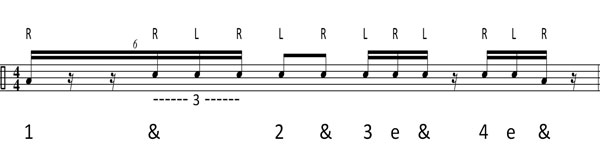
Since I’m right handed, I’ve shown the sticking with a right hand lead, but feel free to follow whatever sticking suits you best. The notation makes the groove look more complex than it is to play, as I needed to correctly notate the 1/16th note triplet on the & of beat 1. Listen to it enough, play along to it, and you’ll soon have it sorted. You should feel the pulse as straight eighth notes throughout the measure.
Supremacy – Verse snippet
As mentioned earlier, the two floor tom hits mimic the original’s orchestral timpani part, and if you lock into this the rest of the snare part falls into place quite easily. As always, the tricky thing is to be able to play the same beat consistently, cleanly, and with the proper subdivisions, for many bars!
Flams? I’ve seen some cover versions on Youtube where people play flams (more a flam-tap idea) during this phrase, but this isn’t what it sounds like on the record, nor is it what Dominic Howard plays during, for example, the Live at Rome Olympic Stadium DVD, and also this show at the Gloria Theatre, Koln in 2015.
UPDATE: See my follow up post on Muse:Supremacy – Verse Stickings for how Dom actually plays this and some alternative sticking options.
Fill #1 in Chorus 1 and 2
This fill appears in Chorus 1 around the 0:32 mark, and in Chorus 2 at around 2:15.
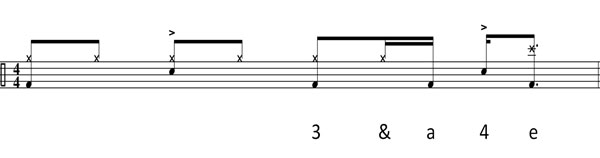
I love simple fills, and this one is so effective, even if it is more a syncopated ending of the main groove rather than a “fill” in the usual sense. Fits perfectly with the music.
Supremacy – Chorus Fill #1
Recorded this on my Roland TD-25kv via USB direct to Studio One on my Macbook Pro. For those interested, the Roland kit you hear is the stock “Rock Stage”, which I think sounds good for this track.
Fill #2 in Chorus 1, 2 and 3
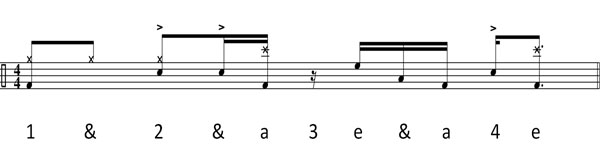
This fill leads us from the main Chorus to the Chorus Toms section, and occurs around the 0:38 mark in Chorus 1, at 2:21 in Chorus 2, and at 4:36 in Chorus 3.
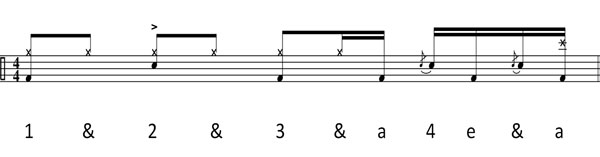
As you can see, it starts in the same place as Fill #1, with a kick drum on the “a” of 3, but this time is followed by a 4 sixteenth note hand to foot linear fill: snare flam, kick, snare flam, kick (with crash), ending on the “a” of 4.
Fill #3 in Chorus 3
Fill #3 only appears once in the entire song in the final Chorus 3, around the 4:29 mark. This is a really classy, musical fill that perfectly follows the orchestral melody.
Chorus Toms section
This section appears three times during the song, at the end of each of the Choruses at 0:39, 2:22 and 4:38, and comprises a series of four sixteenth note single stroke rolls, punctuated by kick/crash hits, played over 5 bars: four of 3/8 and one of 4/8.

In terms of counting this using an eighth note click, each 3/8 bar will be “1 – 2-a-3-a” and the final bar of 4/8 will be “1 – 2-a-3-a-4-a” (or whatever counting method works for you). In terms of performance, just be aware (and respect) that eighth note rest between the end of Fill #2 and the first four strokes on the snare drum. Frankly, just listen to the track – it’s quite obvious what’s going on. Note about sticking: I play these as single stroke rolls, right hand lead.
A final point on this section: although not notated above, when this section is followed by a Verse, the drum part ends with a kick and crash on beat 1 of the first bar of the Verse. At the end of the song, ie when played after the last Chorus, there’s no resolution on to the “1” and the song ends on that last sixteenth note of measure 5 (the 4/8 measure).
Double Time Section
For the less than advanced (or strong intermediate) drummer, this section is probably the most technically challenging part of the song. I am firmly in the camp of those who find this tough and, at the time of writing this, still have a long way to go to get this as clean and accurate as it should be.
What do we have? Assuming we treat this section as 4/4 with a quarter note at 82 bpm, we have 8 measures of madness, broken into three distinct patterns:
- Measures 1-4: Four measures of alternating sixteenth note snare and kick
- Measures 5-6: Two measures of kick on beats 1, 2, 3, 4 (quarter notes) with sixteenth notes on snare and floor toom (unison)
- Measures 7-8: Two measures of kick on the eighth notes (ie double what we had in the previous 2 measures) with same hand pattern, ie sixteenth notes on snare and floor tom, ending with a 32nd note single stroke roll on beat 4 of the final measure. Gulp!
Let’s look at the notation:
Measures 1-2:

For beginner drummers, this alternating snare/kick pattern will be tricky. If you find this too tricky, simplify it by playing the kick in unison with the hands. It won’t sound exactly the same, but works. The swift kick drum double on beat 1 and the “e” of 1 is also tricky, even for more experienced drummers. This too can be simplified by leaving out the kick on beat 1, and just play alternating snare/kick. Note: the hi-hat is being played in unison with the snare. There is a crash hit on beat 1 (measure 1).
Measures 3-4:

More of the same but with a flam played on the snare on the & of beat 4 of measure 4. Once again, playing the fast kick double on the “a” of 4 followed by the kick on beat 1 of measure 5 is tricky. To simplify, just leave out the kick on the “a” of 4.
Measures 5-6:

Most drummers will find that the hardest part is now behind them, and the drum part gets a little easier. Having said that, playing this pattern cleanly and accurately may take some practice. In terms of dynamics, the snare and floor tom are played solidly but not too heavily.
Measures 7-8:

The hands stay with the same pattern, but now the kick is doubled up, ie played on each eighth note. Depending on your drumming level, this can be tricky to get tight and clean, and may take some practice to get right. Finally, the 32nd note single stroke roll on beat 4 of measure 8 is fast. I play this hand to hand, leading with my right hand. Beginners – try the best you can! Speed will come with practice. A possible simplification is to play 4 sixteenth note strokes instead of 8 32nd notes. Although it won’t sound the same played like this, it will work.
And Finally…
That just about wraps it up. I will add some more audio clips to demonstrate the variosu parts notated here, once I have versions that I’m suitably happy with. Please consider subscribing to my site to receive alerts about new content.
Fan of Muse? Want more? Check out my other drumming analysis of Muse songs.
 Ade Drums