Looking for a fun track for drummers featuring straight 8th and 16th note fills, 16th note triplet fills, 8th note triplets, an occasional 32nd note, and even 16th note kick doubles, all in a rocking song within the capabilities of an ambitious beginner with a few miles under his/her belt? Look no further than Always On The Run by Lenny Kravitz and Slash.
This track was the first single released from Kravitz’s 1991 “Mama Said” album, and helped launched Kravitz to stardom. I think I’m right in saying that Kravitz played the drums on the recording.
According to Wikipedia, this song written by Slash was originally destined for Guns’N’Roses, but ended up as this collaboration with Lenny Kravitz.
Song structure is quite straightforward, so let’s dive in and break it down.
Song Structure
Timestamps (m:ss) are as per the album version.
- Intro (0:11) Song starts with Slash’s guitar riff, drums coming in with a 16th note snare single stroke fill starting on the “e” of 3, followed by 8 bars of what I’ll call the “Intro Groove” (as we will come back to this at other points during the song)
- Verse 1 (0:24) Divided into 2 sections, the first being 8 bars of groove (double the length of subsequent verses), followed by 4 bars of the same groove punctuated by crash hits on the 1 and the “&” of 1 in the first of these 4 bars.
- Chorus 1 (0:58) Two lines of chorus (4 bars each) followed by 2 bars of Intro Groove
- Verse 2 (1:17) Same as Verse 1, except overall length is 8 bars, with crash hits on the 1 and the “&” of 1 in the first of the second set of 4 bars.
- Chorus 2 (1:40) Same as Chorus 1. The only difference is a 16th note snare single stroke fill starting on the “e” of 3 of the final bar of Intro Groove, leading into Slash’s guitar solo.
- Guitar Solo (1:58) Now it gets a bit trickier with 2 x 16th note triplet fills on the snare and toms, a syncopated section (quarter-note triplets), and ending with a straight 16th note single stroke snare fill signalling the end of the solo, followed by 4 bars of groove.
- Verse 3 (2:29) Same as Verse 2 (8 bars in total).
- Chorus 3 (2:51) Double length chorus, the key difference being a subtle change to the tom fill at the end of the third and fourth lines of chorus.
- Outro (3:22) Basically an instrumental section with horns, a few drum fills, and the song ending with the (by now) familiar straight 16th single stroke roll (this time played on the snare and toms), followed by two stabs on the kick an crashes to end the song.
Tempo and time signature
Tempo is around 86-87 bpm, and the track doesn’t appear to have been recorded against a click. The song is in 4/4 and has an eighth note pulse, driven by sloshy hi-hats on the eighth notes. Play this with attitude!
Beats and Fills
Intro fill
This straight 1/16th note single stroke snare roll appears more than once in the song. It is important to note that the roll starts on the “e” of beat 3, and as a right-handed drummer I like to use a left-hand lead so that I finish the roll on my left-hand on the “a” of beat 4, leaving my right-hand available to hit the crash cymbal on beat 1 of the following measure. No hard and fast rules here – do what works for you.
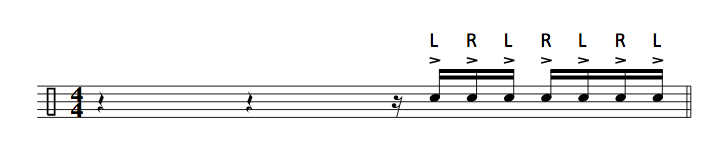
As for knowing when it come in, the Slash guitar riff is a two-bar riff played twice during the Intro section, drums coming in during that final fourth bar. Listen carefully to the guitar riff and you’ll hear a prominent low note played by Slash on beat 3 of that bar, then repeated on the “e” of that beat. The fill starts on that “e”.
Intro Groove
Play this bar 4 times. The tricky bit here (for new drummers) is the 16th note kick drum double. Luckily, the tempo of the song is medium-slowish, so it shouldn’t take too much practice to get right.
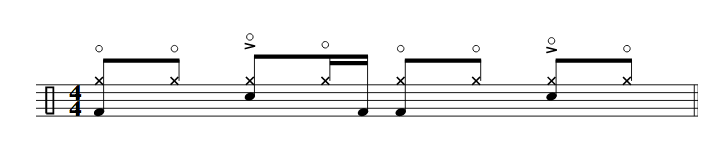
I’ve only notated this with open hi-hats, so take note that the first beat of first measure will be a crash cymbal, ie immediately after the Intro Roll.
Verse Groove
I find it easiest to treat the verses as a series of two-bar grooves, each two bars making up one line of verse, and we can also think of each Verse as being in two sections. The first section looks like this:
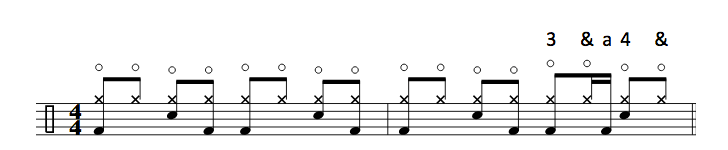
Play a crash on beat one (rather than the open hi-hat) the first time this is played at the beginning of each Verse. In terms of drumming technique, the only trickiness here for new drummers will be the kick on the “a” of beat 3 of the second bar. If it’s too difficult, leave it out, it will sound fine.
In Verse 1, you will play this two-bar groove four times (8 bars total). In Verses 2 and 3, only play this groove two times (4 bars total).
The second section of each Verse, signalled by hits on the crash cymbal(s) at the played on the 1 and the “&” of 1, looks like this:
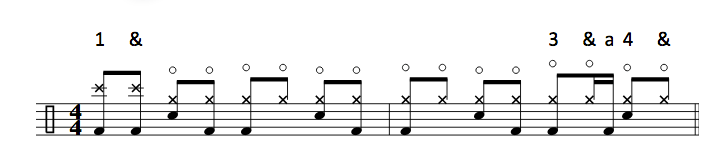
These two bars are followed by one more repeat of the basic two-bar Verse Groove (described earlier), before going to the Chorus.
Chorus
Probably my favourite drum part in the song, we again have a two-bar sequence, this time with the first of the two bars containing some fills, followed by one bar of the Intro Groove we looked at earlier. The two bars together look like this:

The stickings shown here are just my preference, so feel free to use your own. I like to crash using my right-hand, therefore find it easier to use a left-hand lead for the first snare fill. The 32nd note in that snare fill may look daunting, but at this tempo it’s not so bad for “advanced” beginners and intermediate drummers. If you’re a beginner, you will need to work on this. If you have trouble getting this up to speed, you could get away with playing a single stroke roll (2 e & a). However, I would encourage you to try to play it as notated.
For both the first and second Choruses, this two-bar sequence will be played twice, followed by 3 bars of the Intro Groove.
Guitar Solo
The good news is that we have a simpler kick drum pattern. The bad news, for those fairly new to the drumming game, is that we have a couple of 16th note triplet fills, and a syncopated section, both of which will take some work to get smooth and up to speed. On the positive side, both of these tricky bits fit perfectly with the music, and the more you listen to these sections, the more you will “feel” what you are supposed to be playing. Also, as ever, slow everything right down and work on building speed gently, ensuring that your strokes are clean and in time.
Let’s break this down into sections.
We start with playing one bar of the Intro Groove after the second Chorus, followed by this:
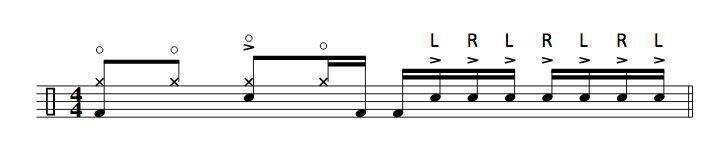
Lenny gives us a useful vocal cue “Slash”, then we play the single stroke roll – which is identical to what we played at the beginning of the song. The tricky aspect is that it is preceded by a double on the kick drum, which certainly took me a bit of practice before I could get my foot and hands to be lined up nicely.
From now on during the Solo, except when playing the fills, we play a simplified version of the Intro Groove, with the kick on beats 1 and 3 only – no need for the 16th note doubles we normally play in this groove.
After one full bar of the simplified Intro Groove, we get the first of the 16th note triplet fills, which looks like this:
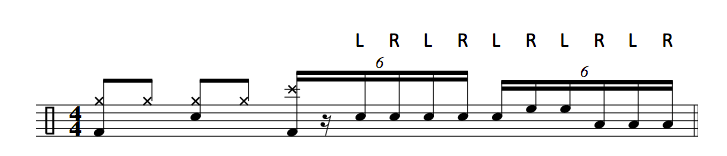
The first half of the bar is straightforward, except for the crash cymbal with the kick drum on beat 3. Then things get interesting! If you ignore the first snare hit of the fill for a moment, we have basically got three triplets: one the snare, then one played on the snare and the high tom, and one on the floor tom. Each of those triplets fits in teh same time space as a straight 8th note, so if you can keep in ind that 8th note pulse, but each 8th note gets three notes (three 16th note triplets), it all starts to make sense and is easier to internalise. Then, going back to that initial snare hit we ignored, we can think of this as a pick-up note played immediately before the first of those three triplets. Well, this kind of thinking helped me understand what is going on.
A word about sticking. Based on that idea of this being three sets of triplets, with a pick-up note immediately beforehand, and as I’m right-handed, this sticking makes sense for me. IT also means that the first of the two hits on the high tom will be with my right hand – which I prefer. However, the down side is that I end the roll on my right hand on the floor tom and there isn’t enough time (for me) to get that hand from the floor tom to my right side crash cymbal. Therefore, I come out of this crashing using my left hand on my left side crash cymbal. I must admit that this took some practice as I very rarely crash using my left hand. But I’m glad I persevered, as I now feel more confident crashing with my left hand. Anyway, this is my thinking and preferences – feel free to do what works for you.
Next up, we have another bar of simplified Intro Groove (with a crash on beat 1), then the syncopated fill, which looks like this:
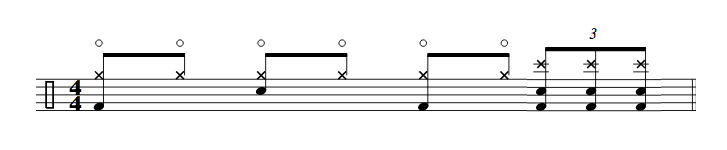
This isn’t particularly difficult, but it needs to be strong and on time.
This is followed up another bar of the simplified Intro Groove leading us to a repeat of the 16th note triplet fill we played earlier in the Solo. I always play the two fills identically – which seems correct to me – though some transcriptions I have seen online do show minor differences in the instrumentation.
To finish the Solo, we then have another full bar of simplified Intro Groove, followed up the straight 16th note fill we played during the Intro and at the beginning of the Solo. These two bars look like this:
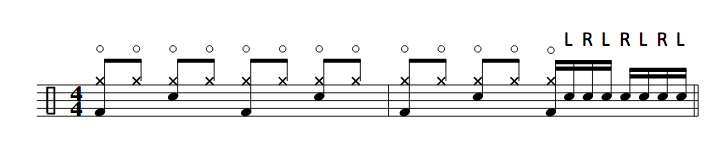
The only thing to look out for here is that we’re back to a straight 16th note single stroke roll, which can feel a little strange after the faster 16th note triplets played earlier.
Verse 3
This is the same as Verse 2 and uses the same Verse Groove we looked at in detail earlier on.
Chorus 3
The main difference here is that the Chorus is twice the length, ie 4 x two-bar sections, and the third and fourth time we play the fill it is slightly different. Therefore, play this two times:
Then play two times again, replacing the first bar fill with this:
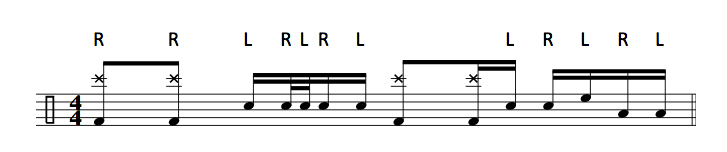
The difference here is that we have an extra note played on the snare on the “a” of beat 3. Note that when we come to the end of the fourth time around, we revert to the simplified Intro Groove, ie single kick on beat 3 of the second bar.
We then have two more bars of simplified Intro Groove before launching into the Outro.
Outro
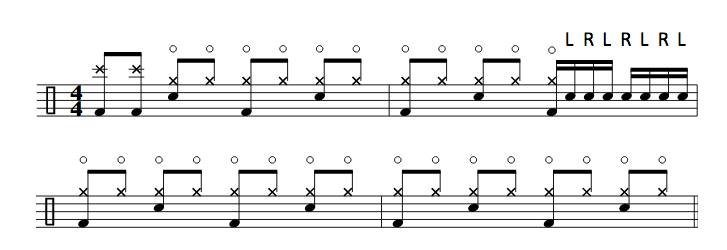
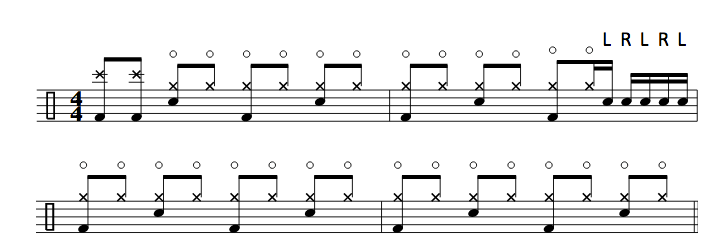
This features more guitar soloing and some horns to spice it all up. Everything we play during the Outro is either a repeat of something we’ve already covered, or a very minor variation. I like to think of it as three lines comprising two 4-bar sections followed by one 2 bar section, then the actual ending (in what would be a third bar).
The two 4-bar sections start with crashes on the 1 and the “&” of 1 of the first bar of simplified Intro Groove, followed by a bar containing a fill, then two more bars of simplified Intro Groove. The third time around we only play two bars (including a fill), then finish on two crashes on the 1 and the “&” of 1 of what would be a third bar.
First section:
Second section:
Third (and final) section:
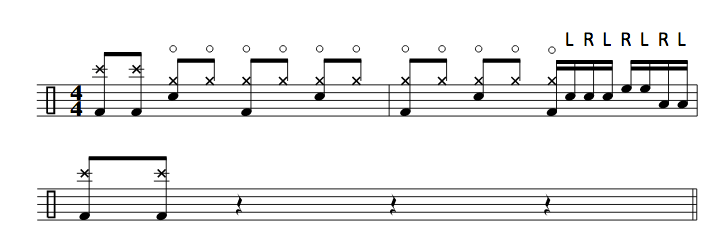
As you can see, this 10 (and a half) bars contain things we’ve seen already, or minor variations, and shouldn’t be difficult to string together.
Let’s wrap it up
Hope this useful. I can’t guarantee that these transcriptions are 100% accurate, but they seem good to me. As this format isn’t designed for playing along when sitting at the drum kit, if I get a chance I’ll post up the entire transcription as a PDF. If that would be of interest, leave a comment and I’ll see what I can do!
 Ade Drums